The LULUCF sector covers emission estimates from Land Use, Land Use Change and Forestry. This sector differs from the other sectors because both emissions and uptake of greenhouse gases occur. The majority of emissions and uptake relate to gains and losses of carbon in organic matter in living and dead biomass as well as in soils. The inventory methodology for LULUCF is based on a mapping (the land use matrix) of Denmark into the six IPCC land use classes: Forest land, Cropland, Grassland, Wetlands, Settlement and Other Land.
Denmark is a country intensively utilized for agricultural production, where most of the area is affected by agriculture. In 2024 approximately 2.7 million hectares of the total Danish land area is reported under Cropland, corresponding to 63.4 % of the land area, while 15.5 % is forested. In combination with a high number of cattle and pigs, there is a high environmental pressure on the landscape. To reduce this impact, policy measures have been adopted to protect the environment and mitigate greenhouse gas emissions. The distribution and registered changes in the different land use categories from 1990 – 2024 is presented in Table 1.
Table 1. Distribution and registered conversions between the different land use categories from 1990 to 2024 in hectares.
| 1990/2024 | Forest land | Cropland | Grassland | Wetlands, periodically water covered | Wetlands, Lakes | Settlement | Other land | Total, 1990 |
Forest | 522,842 | 10,420 | 2,467 | 49 | 303 | 2,777 | 0 | 538,859 |
Cropland | 128,429 | 2,717,947 | IE | 8,740 | 4,600 | 54,269 | 0 | 2,913,985 |
Grassland | 15,276 | IE | 188,212 | 8,288 | 2,707 | 7,297 | 0 | 221,780 |
Wetlands, periodically water covered | 0 | 358 | 358 | 48,974 | 857 | 89 | 0 | 50,636 |
Wetlands, Lakes | 75 | 39 | 41 | 0 | 59,473 | 119 | 0 | 59,747 |
Settlements | 0 | 0 | 0 | 0 | 0 | 494,072 | 0 | 494,072 |
Other | 0 | 0 | 0 | 0 | 0 | 0 | 26,575 | 26,575 |
From Sea | 0 | 0 | 42 | 0 | 2 | 494 | 0 | 538 |
Sum | 666,622 | 2,728,764 | 191,121 | 66,051 | 67,941 | 559,117 | 26,575 | 4,306,191 |
Percentage | 15.5% | 63.4% | 4.4% | 1.5% | 1.6% | 13.0% | 0.6% | 100.0% |
IE: Included elsewhere.
The greenhouse gas emissions are the product of the distribution between land use categories and the conversions between them. The land use matrix is updated annually with new information from public registers, maps etc., identifying the annual land use changes taking place from one category to another, caused by e.g. afforestation projects, the need for more urban settlements and infrastructure, or efforts to restore wetlands. Aside from emissions and removals related to the main land use categories, the minor emission sources of harvested wood products and biomass burning (fires) are also included in the LULUCF sector.
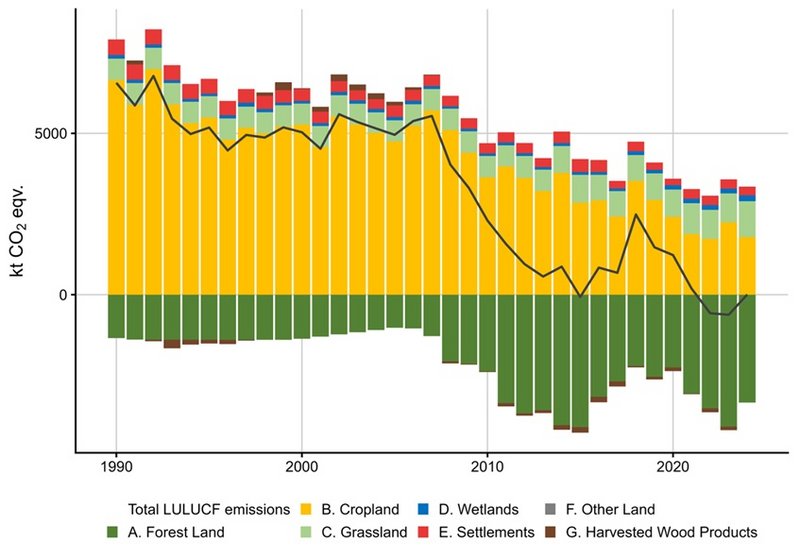
In 2024, LULUCF was estimated to be a net sink of emissions at 381 kt CO2 equivalents. Figure 1 presents the historical emissions from LULUCF from 1990 to 2024 from the different land use categories along with the total net emissions. In the past 5 year period (2020-2024), the LULUCF sector has on average been a net source of emissions at 1 130 kt CO2 eqv., which corresponds to close to 83 % reduction from the base year of 1990, but there are large yearly variations in the sector, since it is highly impacted by e.g. varying climatic conditions affecting the biological factors of growth, decomposition, yield etc. In both 2022 and 2023 the sector had net removals of greenhouse gases in CO2 eqv. Net removals were also found in 2015, and the emissions for 2024 were near-zero. Since 1990, there has been a general negative trend in greenhouse gas emissions from the LULUCF sector, driven both by uptake in Forests and reductions in emissions from the other land use categories, Cropland in particular.
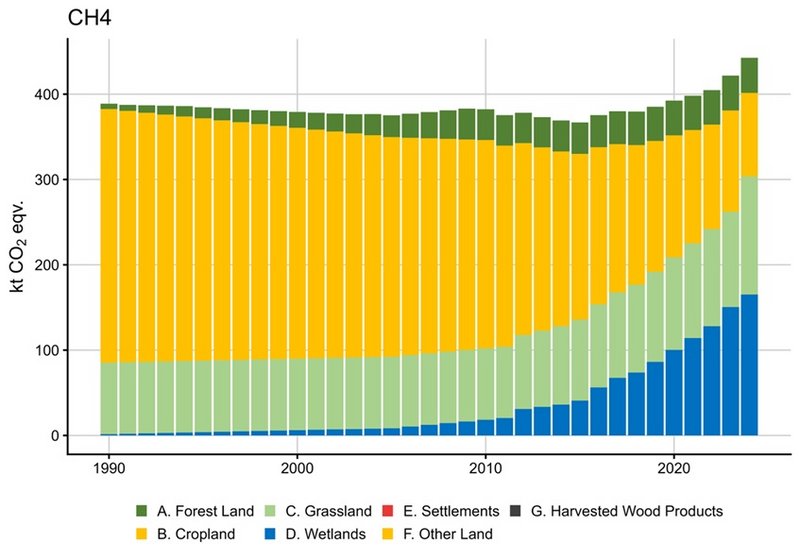
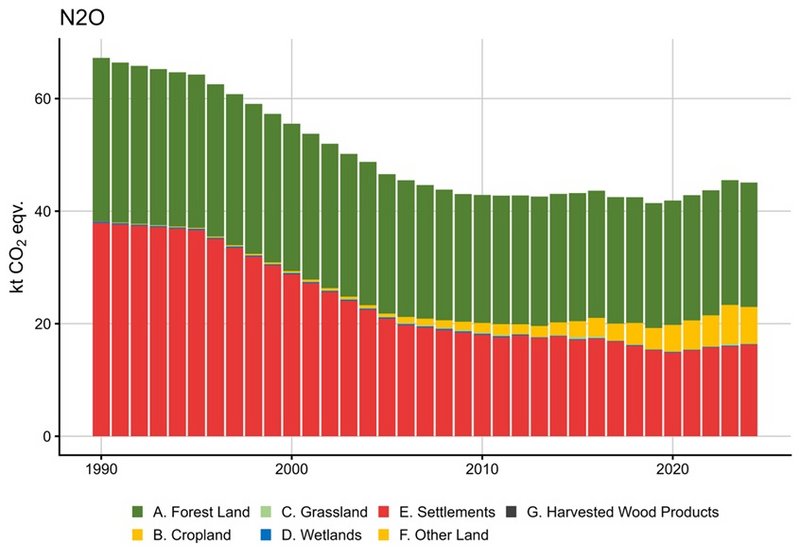
LULUCF reports on the following greenhouse gases:
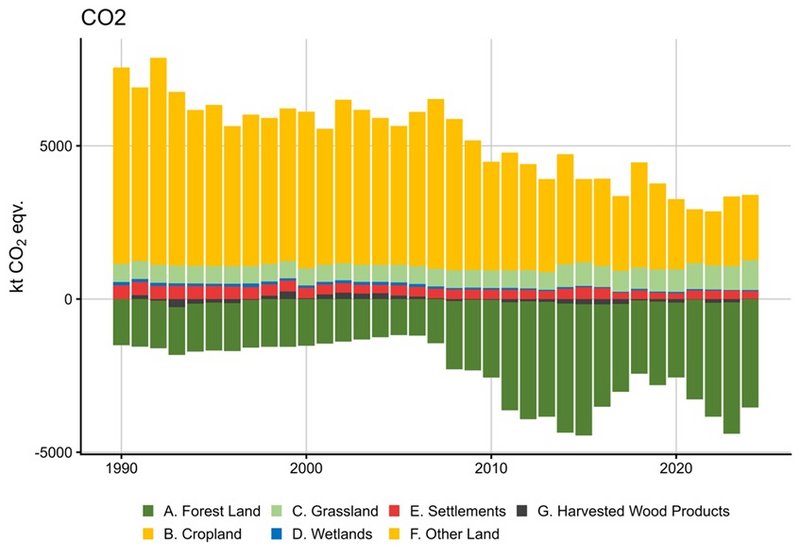
The total area with forest in 2024 has been estimated to 666 622 hectares covering 15 % of the land area. Of this area, a total of 538 859 hectares were planted before 1990. 1990 to 2024 afforestation has taken place on 143 780 hectares and deforestation on 16 017 ha. A large part of the deforestation is conversion of areas with Christmas trees (defined in the matrix as Forest land) into Cropland, as part of the usual crop rotation and removal of forests on sandy heathland converting them into Grassland.
The Danish forests have been estimated to be a net sink of 3 343 kt CO2 eqv. in 2024. The forests have been a sink of around 3 100 kt CO2 eqv. annually in the last 10 years. The emission inventory for Forest land and harvested wood products is conducted by the Department of Geosciences and Natural Resource Management (IGN), at University of Copenhagen. The methodology and detailed information on the emissions from these sources are reported in the National Forest Inventories (opens new window).
Cropland is defined as land intensively utilized for agricultural purposes and includes arable and tillage land, and agroforestry systems, where vegetation falls below the thresholds used for the forestland category. Grass, which is part of a frequent agricultural rotation cycle is included in the Cropland category, whereas the Grassland category includes heath, rangelands and grazing land that is outside rotation and therefore not considered Cropland. In total, the area with Cropland and Grassland covers 68 % of the Danish territory, corresponding to approximately 2.7 million and 191 000 hectares, respectively.
The total emissions from Cropland range from being a net source of 6650 kt CO2 eqv. in 1990 to a net source of 1788 kt CO2 eqv. in 2024. From 1990 and onwards, a general decrease in the emission from Cropland is estimated due to a continuously smaller area with cultivation of organic soils leading and increased input of organic matter into the cultivated mineral soils.
Emissions reported under Grassland, where the dominant source is organic soils, has increased since 1990 to 1107 kt CO2 eqv. in 2024 due to a larger area of organic soils in Cropland has been converted to permanent grassland.
Restoration of Wetlands on organic soils help to decrease the emissions, but cultivation and drainage of organic soils within Cropland and Grassland continues to be the main source of emissions in the sector, amounting to 2 806 kt CO2 eqv. in 2024. However, the emissions have decreased significantly over time, partly due to rewetting of previously drained soils, but also due to the cultivated soils losing carbon resulting in lower estimated emissions.
Wetlands are sub-divided into flooded wetlands (permanently water covered) and periodically water covered wetland. Periodically water covered area includes peat excavation areas on organic soils, the drainage of which was affecting around 800 hectares in 2024.
The emission from peat extraction have decreased over the years due to a decrease in the activities in Denmark. However, restoration of former wetlands primarily on Cropland and Grassland increase CH4 emissions from Wetlands which has the consequence that the overall emission from Wetlands has increased from 111 kt CO2 eqv. in 1990 to 180 CO2 eqv. in 2024.
Settlements cover a slightly increasing area according to the land use matrix, in 2024 estimated at 13.0 % of the Danish area, at 559 117 hectares. The land use category is a relatively small source of emissions, which primarily stem from conversions of Cropland and Grassland to Settlements and the associated loss of living biomass and carbon stock in the soil. The emissions in 1990 were estimated at 485 kt CO2 eqv., in 2024 reduced to 265 kt CO2 eqv.
Other land is defined as land with little or no vegetation and consequently no or very limited carbon stocks. The land use type includes beaches and sand dunes and a very small insignificant area with rocks and cliffs, in total estimated to be 26 574 hectares. As the area is kept constant in the land use matrix over the entire period of the inventory, no land use changes and hence no emissions are reported.
Emissions from biomass burning (fires) in Denmark are negligible, around or below 1 kt CO2 eqv. for the entire period of the inventory in the period 1990-2024.
Some background information can be found here:
The following links are different zips of the same emission map, both requires GIS to read:
